Reflex MR
Stimson Yachts Ltd
Now based in Auckland, New Zealand, designer Christian Stimson first
got the boating bug when his Naval father threw him in a dinghy aged 11
or 12. His career path was decided a few years later when he picked up a
prospectus for the Southampton Institute and the page fell open on the
page about its prestigious yacht design course.
Stimson graduated in 1987 and was quick to grasp the benefits of computer-aided design. Recognising he was ahead of the game in this respect, he set himself up as a freelance designer in Cowes soon after graduation.
Subsequently, Stimson has avoided being pigeon-holed in his work, deriving satisfaction from designing superyachts and powerboats right through to small racing boats. Career highlights include designing the Reflex 38 for Clipper Ventures in 1999 and joining the GBR Challenge America's Cup team in 2002. Now working out of New Zealand, current projects include an 50 foot catamaran in production in Taiwan and a 56-foot lift keel cruiser which is in build in the UK.
For Stimson, designing a boat for the WMRT is a natural extension of the match racing work he has done in his career. But he acknowledges it is not an easy project to pull off: "Designing a yacht that the world's best sailors finding demanding yet rewarding that also has the good manners and stability to allow novices and VIPs to enjoy a day on the water is no small one - but one we relish."
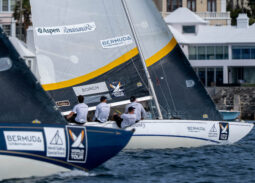
His solution is the Reflex MR, a 38-foot boat which fits in a 40-foot container, has some clever details to reduce damage and ease repair and a long, slender hull which Stimson believes is "as effective as it is attractive". The design can be reconfigured to suit a race mode or corporate mode, he adds: "For corporate or training activities, the rig can be reconfigured. The helm, being a wheel, needs to be as large as possible for match racing, but for corporate days a smaller wheel is easily fitted."
While design flexibility is key, Stimson stresses that the success of the WMRT as a sporting spectacle demands designs that can deliver exciting racing. "Match racing requires yachts to have excellent handling characteristics, and much design time was spent on the foils to achieve this using state of the art CFD and VPP software."
In terms of where the boat will work best, he has not tried to second-guess the needs of particular venues or sets of conditions: "There are pitfalls in doing that. This design that can be adapted so it is competitive in any scenario."